International families near Saint-Germain-en-Laye: what changes when home moves countries?
A systemic look at expat families, adolescent stress, language and cultural transitions near Saint-Germain-en-Laye, Chatou and the Yvelines.

When families move countries, we often talk about the exciting parts first. A new school. A new language. A new city. Maybe a professional opportunity, or a chance for the kids to grow up with a broader view of the world.
All of that can be true. And still, the move can put pressure on the family system in ways that nobody expected.
One parent might be thriving at work while the other feels like the family project manager: appointments, school forms, language questions, doctors, playdates, transportation, visas, the invisible work of making life function. One child may adapt quickly, while another becomes anxious, oppositional, or withdrawn. A teenager may look "fine" at school, but come home exhausted from translating themselves all day.
When that happens, it can be tempting to locate the problem in one person. The anxious child. The angry teenager. The parent who is "too stressed." From a systemic point of view, I would want to slow that down. What if the symptom is not the problem, but the signal?
Acculturation is not just learning the local rules
Researchers use the term acculturative stress to describe the strain that can come with adapting to a new cultural environment. The research is mostly based on immigrant families, often in the United States, so it does not map perfectly onto every international family in France. Still, the patterns are useful.
Studies on immigrant families show that cultural stress can affect family functioning, parent-child communication, parental emotional health, and adolescent symptoms. That does not mean moving abroad causes mental health problems. It means that cultural transition is a real stressor, and families need enough support and flexibility to absorb it.
In adolescence, this matters even more. The World Health Organization describes adolescence as a formative period in which identity, peer relationships, home life, school pressure and supportive environments all shape mental health. For international teens, identity is often not a simple question. "Where are you from?" can become strangely hard to answer.
The child who adapts fastest may not be the least stressed
In international families, children sometimes learn the new system faster than their parents. They understand the school culture, the slang, the social rules, or the administrative language. Adults may be relieved by this. The child looks capable. The family is functioning.
But being capable is not the same as being okay. When a child becomes the bridge between cultures, they may also become the holder of tension between worlds. They may feel loyal to one parent, embarrassed by another, protective of a sibling, or angry that nobody understands how much effort is required to belong.
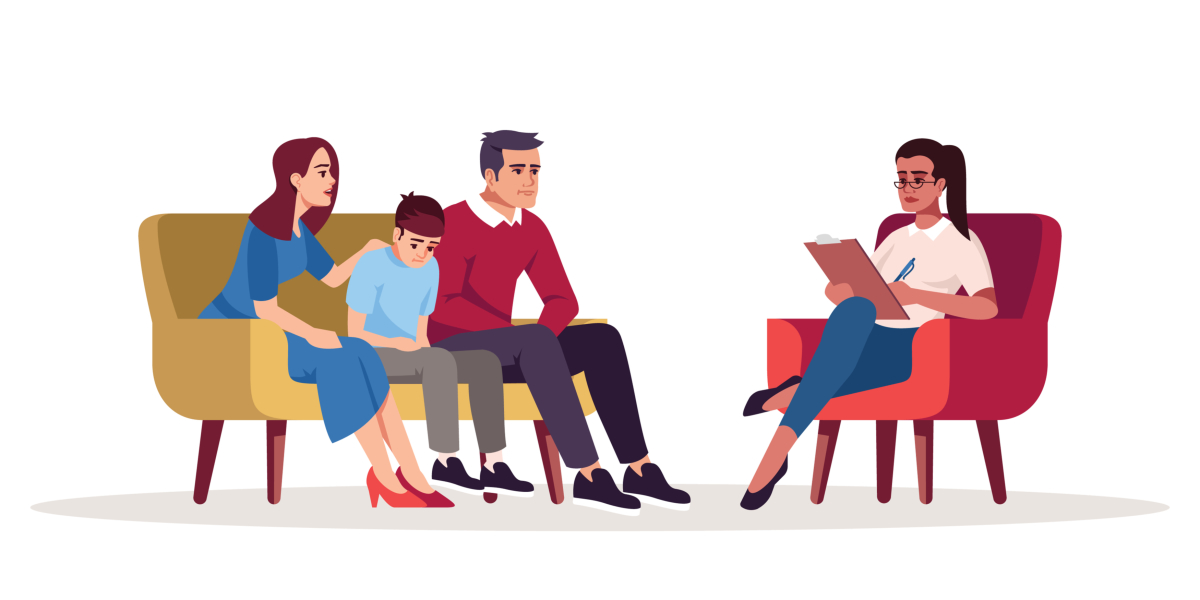
This is where family therapy can be helpful. Not because the family has failed, but because the system is carrying more than it can comfortably metabolize.
Why a systemic approach fits international families
Systemic family therapy looks at interactions. Who speaks for whom? Who withdraws when things get intense? Who becomes the translator, the peacekeeper, the identified problem, the "strong one"? What rules did each parent bring from their own family or culture? Which rules still help, and which ones are creating more conflict than connection?
Couple and family therapy research has grown substantially over the last decades. The evidence is not a magic wand, and not every family-based intervention is equally strong for every problem. Still, the broader field is built on a simple and well-supported idea: close relationships are involved in how many emotional and behavioral problems develop, are maintained, and can improve.
For families near Saint-Germain-en-Laye, Chatou, Le Vesinet, Croissy-sur-Seine and the Yvelines, the international context is not a side detail. It may be part of the clinical picture: language, school expectations, belonging, relocation stress, distance from extended family, and the couple's own cultural negotiation.
Working in more than one language
Language is not neutral in therapy. Some people can describe work stress in English, family pain in French, and childhood memories in Spanish. Some children use one language for closeness and another for rules. Some couples switch languages when they want more emotional distance, or when one word simply does not exist in the other language.
Multilingual therapy research increasingly recognizes that code-switching can carry emotional, relational and even power meanings in the room. In family therapy, this is especially important. If one family member understands everything and another does not, language can include, protect, isolate or silence.
That is why, with international families, I pay attention not only to what is said, but also to which language it is said in, who understands it, and what changes when the language changes.
Some of the articles and resources I used for this piece
- World Health Organization. (2024). Adolescent mental health fact sheet.
- Wu, S., et al. (2020). Familial acculturative stress and adolescent internalizing and externalizing behaviors in Latinx immigrant families. Journal of Immigrant and Minority Health.
- Lorenzo-Blanco, E. I., et al. (2017). Longitudinal effects of Latino parent cultural stress, depressive symptoms, and family functioning on youth emotional well-being and health risk behaviors.
- Wittenborn, A. K., & Holtrop, K. (2022). Evidence base update on couple and family interventions, 2010-2019. Journal of Marital and Family Therapy.
- Verkerk, L., Fuller, J. M., Huiskes, M., & Schuppert, A. (2023). Expression and interpretation of emotions in multilingual psychotherapy: A literature review. Counselling and Psychotherapy Research.